DWELL BEYOND THE ORDINARY
Small log cabin kits appeal to buyers seeking compact space, natural materials, and a simpler building process. Yet a kit is not a finished cabin. Buyers still need to compare timber specifications, insulation, roof design, delivery terms, and the work required on site. A neat catalog image rarely shows the whole project.
The wider building sector gives this choice added context. The UN Environment Programme’s 2022 Global Status Report for Buildings and Construction estimated that buildings and construction accounted for 34% of global energy demand and 37% of energy- and process-related carbon dioxide emissions. Those figures describe the sector, not the footprint or energy performance of any individual cabin. Still, they underline why material sourcing and building efficiency deserve careful attention. Small log cabin kits vary widely, and a low purchase price alone says little about long-term value.
This guide examines ten manufacturers in China, focusing on product range, timber details, customization, documentation, and communication. These are practical starting points, not automatic endorsements. Ask suppliers for clear drawings, wood species and grades, treatment details, packing lists, and written delivery terms. Check whether the quoted kit includes windows, doors, roofing, and insulation; these details can change the real cost. And be cautious: published specifications may not answer every question. A careful comparison can help buyers identify a suitable supplier, but independent verification remains essential.
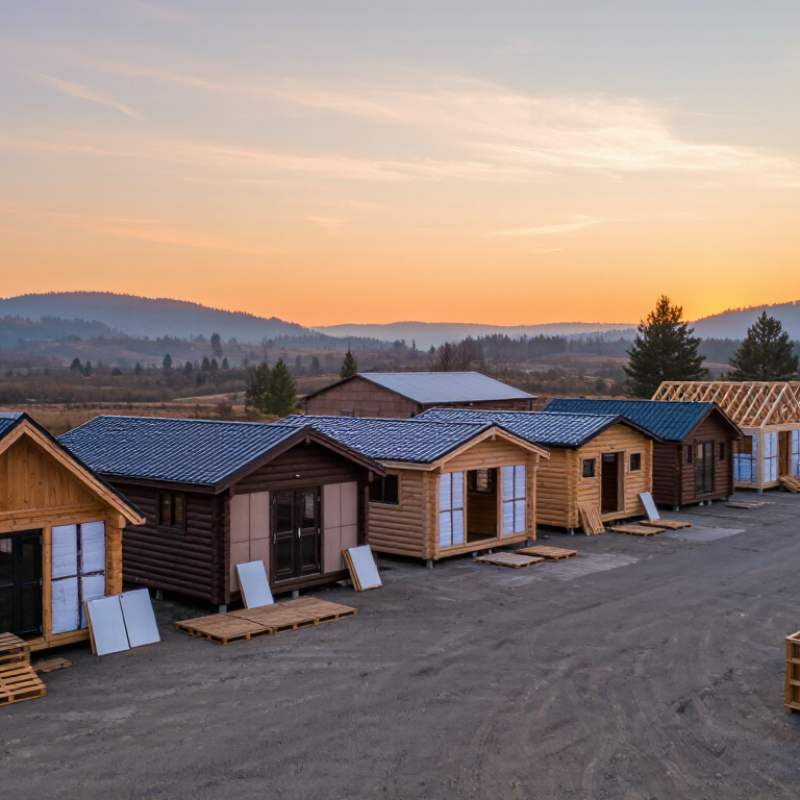
A practical comparison needs a clear definition of “small.” Here, treat a small log cabin kit as a design with no more than 1,000 square feet of enclosed floor area. That is a working cutoff, not an industry-wide standard. For context, the U.S. Census Bureau reported a 2,286-square-foot median floor area for new single-family homes in 2023. A compact 600-square-foot plan can fit a sleeping loft and a small kitchen, but usable space depends on stairs, partitions, and ceiling height—not floor area alone.
Wall logs should be compared by actual thickness, profile, species, and moisture condition. A 6-inch nominal log may not provide six inches of solid wall after milling. Check whether the kit specifies machined dimensions and how corner joints are sealed. Details matter. The USDA Forest Products Laboratory’s 2021 Wood Handbook explains that wood properties vary with species and moisture content, so a single strength claim cannot describe every log package. Ask for the structural grading basis, grade marks, and any supporting test data for beams and roof timbers. Decorative appearance is not a structural grade. I would also verify how the supplier distinguishes load-bearing logs from trim; kit descriptions can leave that point unclear.
There is no single universal floor-area threshold that defines a “small” log cabin kit. Compare a kit’s stated floor area and nominal wall-log thickness, then check whether any structural timber is graded to a recognized standard. The chart shows characteristic bending-strength values for EN 338 strength classes; these are not allowable design stresses. Structural design must also account for applicable design factors, loads, and local building requirements.
Ranking China’s top 10 small log cabin kit manufacturers calls for evidence, not polished brochures. Compare documented production capacity, relevant certifications, and verifiable export activity. Capacity figures should identify the reporting period and distinguish installed output from actual annual production. A factory with several lines may still face seasonal delays or material shortages.
Certifications matter only when their scope matches the product and process being assessed. Check issuing bodies, validity dates, and whether documents cover the facility, materials, or finished kits. Export data can reveal shipping history, but public records may be incomplete or grouped through trading companies. Treat rankings as a practical shortlist, not proof that one supplier will suit every project. Some records are messy. That deserves a second look.
Tips: Request recent production figures, certificate copies, and shipment references for comparable cabin kits. Ask for a dated lead-time estimate and a sample bill of materials. Then compare the same specifications across suppliers; otherwise, capacity and price figures may not be meaningfully comparable.
A useful comparison of small log-cabin kit manufacturers starts with the actual product, not a polished cabin photograph. Record whether each kit includes roof boards, floor framing, fasteners, windows, and installation drawings. Log dimensions matter: a 44 mm wall profile and a 70 mm profile differ in mass, appearance, and insulation potential. Ask whether stated thickness describes one wall or a laminated assembly. Small wording differences can change the quote.
Customization should be checked against production limits. Compare available log lengths, corner joints, door openings, roof pitch, and window placement. Request a dimensioned plan and a written list of included components. The USDA Forest Products Laboratory’s 2021 Wood Handbook explains that wood below roughly 30% moisture content can shrink as it dries. That makes moisture control, storage instructions, and clear assembly tolerances relevant—not minor details. Still, buyers should confirm the manufacturer’s figures for the selected timber and climate.
Production standards deserve the same scrutiny as design options. Ask how timber is graded, dried, inspected, and protected during shipment. Request test records or documented quality checks rather than relying on broad claims. The 2024 Global Status Report for Buildings and Construction reports that buildings and construction account for about 32% of global energy demand and 34% of energy- and process-related CO₂ emissions. For a small cabin, insulation details and air leakage still deserve attention. Details matter. Specifications can look complete while leaving practical gaps.
| Profile | Typical Product Focus | Indicative Log / Wall Dimensions | Common Customization Requests | Production & Quality Checks | Standards / Documents to Request |
|---|---|---|---|---|---|
| Profile 01 Compact garden cabin |
Small storage, hobby, or garden-use cabin kits | Interlocking wall logs often quoted around 28–44 mm thick; ask for the finished profile drawing and usable wall height. | Door and window positions, roof style, floor kit, surface coating, and flat-pack dimensions | Check component labeling, moisture condition, machining consistency, and a complete packing list. | Request the applicable timber grading information, product drawings, inspection records, and any claimed management-system certificate with its scope. |
| Profile 02 Insulated-use cabin |
Small cabins designed for more frequent or seasonal use | Solid log options may be quoted around 44–70 mm; insulated wall systems require separate layer-by-layer specifications. | Insulation build-up, vapor-control layers, glazing, roof insulation, and floor insulation | Verify wall-section details, insulation type and thickness, and whether the quoted thermal performance applies to the whole assembly. | Request assembly drawings and test evidence relevant to the destination market; do not infer whole-building performance from log thickness alone. |
| Profile 03 Traditional interlocking-log kit |
Small cabins with profiled logs and corner-interlocking joints | Profile thickness is often specified separately from log face height; obtain both dimensions and the joint profile. | Corner-joint style, log profile, roof overhang, opening locations, and finish options | Inspect sample joints, machining tolerances, moisture-related installation guidance, and replacement-part availability. | Request a bill of materials, assembly instructions, timber species declaration, and any applicable structural design documentation. |
| Profile 04 Flat-pack leisure cabin |
Knock-down kits intended for containerized or parcel-style shipment | Ask for individual wall-board thickness, board width, floor-board thickness, and roof-board thickness; these are not interchangeable dimensions. | Panelized packing, hardware packs, multilingual instructions, and shipping-carton configuration | Confirm package dimensions and weights, hardware counts, moisture protection, and pre-shipment inspection procedures. | Request packing lists, assembly manuals, material declarations, and export documentation appropriate to the destination country. |
| Profile 05 Small studio or workspace kit |
Garden studios and compact workspaces with larger glazed openings | Request the structural wall specification around openings; quoted log thickness alone does not establish load capacity. | Window size, door configuration, electrical-preparation options, and interior lining | Check opening reinforcement details, glazing specifications, and whether the design has been assessed for local wind and snow loads. | For relevant projects, ask a qualified local designer to review the kit against applicable building rules and structural design requirements. |
| Profile 06 Small sauna or outbuilding kit |
Compact sauna shells and related garden outbuildings | Confirm wall, roof, and floor build-ups separately; sauna-area materials and insulation details may differ from a standard cabin kit. | Bench layout, heater opening, ventilation, door type, and heat-resistant interior materials | Verify clearances and installation instructions for the selected heater; confirm that electrical or heater work is handled by qualified professionals where required. | Request material and heater documentation relevant to the destination market; confirm local fire, electrical, and ventilation requirements. |
| Profile 07 Low-profile summerhouse |
Seasonal garden rooms and simple recreational cabins | Common quotations distinguish wall-log thickness from roof and floor board thickness; request all three measurements in writing. | Veranda, roof covering, floor kit, glazing, and optional paint or stain | Check that the quote defines included roofing, floor components, fasteners, and weatherproofing materials. | Request drawings, installation instructions, timber specification, and clear exclusions for foundations and site works. |
| Profile 08 Heavy-log appearance kit |
Small cabins using larger-section logs for a substantial appearance | Heavier profiles may be quoted at approximately 70 mm and above; verify actual profile dimensions, weight, and connection details. | Log profile, corner treatment, roof structure, lifting or handling plan, and finish | Confirm structural calculations where needed, component weights, handling requirements, and suitable foundation assumptions. | Where structural timber is specified, request the relevant grading and design documentation for the market and project conditions. |
| Profile 09 Modular panel cabin kit |
Small cabins supplied as preassembled or panelized wall sections | Ask for total panel thickness and a section drawing showing framing, sheathing, insulation, and finishes. | Panel dimensions, opening locations, cladding, insulation, and services routes | Review panel identification, connection details, dimensional tolerances, and protection during storage and shipment. | Request panel drawings, material declarations, installation sequences, and any applicable test reports for the complete panel system. |
| Profile 10 Custom-design small cabin kit |
Made-to-order kits based on a buyer’s layout or project brief | Dimensions should be specified on approved shop drawings, including tolerances and the measurement convention used. | Custom footprint, openings, roof pitch, cladding, finish, and accessory package | Agree drawing approval, sample approval, change control, inspection hold points, and acceptance criteria before production. | Ask for the applicable technical file and certificates; ISO 9001 or ISO 14001 should only be treated as a claim after checking a valid certificate and its scope. |
When comparing small log cabin kits, EN 14081-1 and ISO 9001:2015 address different questions. EN 14081-1 concerns structural timber placed on the market for load-bearing use, including strength grading and declared performance.
ISO 9001:2015 is a quality-management standard, not proof that a cabin is structurally safe or compliant with every local building rule. It can indicate documented controls for purchasing, production checks, nonconformities, and corrective action.
There is room for uncertainty: a tidy factory process cannot compensate for unclear load calculations or poor installation guidance. A careful comparison needs both product evidence and practical review.
For China’s small log cabin kit manufacturers, compare the delivered price, not just the advertised kit price. Ask whether the quote includes treated logs, roof materials, windows, fasteners, packing, and inland transport. The National Association of Home Builders’ 2024 Cost of Construction Survey found that construction costs represented about 64.4% of a typical home’s final sale price. A cabin kit is not a complete house, but the finding highlights why missing scope items can distort comparisons. Request a written bill of materials and a list of exclusions. Then check how exchange rates, port handling, and local unloading affect the final figure. Small charges add up.
Delivery promises need dates and conditions. Ask when production starts, how long quality checks take, and what happens if a shipment misses its window. The World Bank’s Logistics Performance Index 2023 evaluates shipment timeliness alongside customs and infrastructure; that is a useful reminder that factory lead time is only one part of delivery. Get estimated production and transit times separately. For installation support, confirm whether drawings identify each log, roof connection, and moisture barrier. Ask who answers technical questions during assembly. After-sales service matters too: request a written process for damaged parts, missing components, and replacement shipments. Check response targets and warranty exclusions. Keep the emails. They are useful, though not a substitute for clear contract terms. A slightly awkward truth: even good instructions may leave a first-time installer guessing.
“I went to the woods because I wished to live deliberately, to front only the essential facts of life, and see if I could not learn what it had to teach, and not, when I came to die, discover that I had not lived.”
- Henry David Thoreau